
Traditional Marketing Vs Digital Marketing
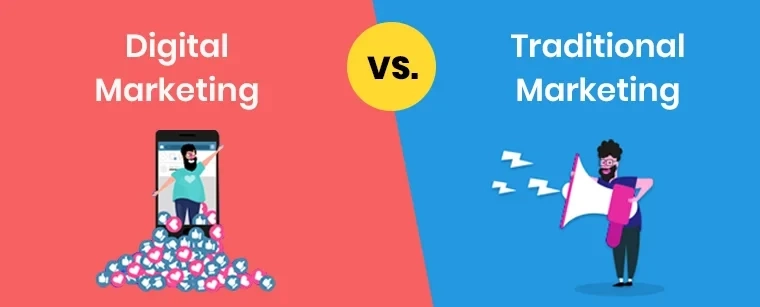
Traditional marketing and digital marketing both seek to connect companies with individuals, but they do so in distinct manner. Traditional marketing employs familiar offline channels such as newspapers, TV advertisements, radio, and billboardsmethods that many individuals trust due to their long-standing presence. In contrast, digital marketing shifts interaction into the online area through social media, websites, email, and search engines, facilitating instant customer engagement and real-time communication. Together, these strategies illustrate the progression of marketing from straightforward printed communications to interactive, two way digital dialogues that enable businesses to better understand customer needs and cultivate stronger relationships.
Broadcasting to the Masses vs Connecting Through Meaningful Digital Interactions
Traditional Marketing resembles organizing a fantastic meeting in the real world. it depends on physical, often one sided channels such as the large billboard you see while driving, the advertisement you view on television, the magazine ad you scan, or the leaflet that arrives in your mailbox. It aims to cast a broad, public net to generate general awareness and trust, utilizing well known and time tested techniques that have proven effective over many years. It engages with the shared, communal venues of our everyday existence. Digital Marketing, on the other hand, is akin to participating in countless smaller, highly targeted discussions chance within screens across social media platforms, email inboxes, search engine results, or specific online pages. It focuses on being readily available and reaching people right where their attention already resides on their laptops and smartphones.
Where Traditional Impact Meets Digital Intelligence
Traditional marketing functions like a one way loudspeaker, broadcasting your message while hoping for positive outcomes, without a clear understanding of who has received it or whether they feel inclined to react. Conversely, digital marketing provides an interactive dialogue, supplemented by a note taking feature. Each click, view, share, or purchase is monitored, eliminating the need for speculation you can quickly determine that your advertisement performs better at 7 PM on Instagram than at 9 AM on Facebook, allowing for immediate tweaks. This remarkable, data driven insight facilitates targeted advertising, enabling you to discontinue showing dog food ads to cat owners, thus enhancing the effectiveness and relevance of your marketing budget.
In the end, a wise company doesn’t pick one option over the other but rather selects the ideal combination for its target audience. Traditional marketing continues to be valuable for establishing credibility and reaching specific community (such as older individuals or those with limited internet access), and it effectively creates a real brand identity. However, when it comes to speed, cost effectiveness, and connecting with a highly engaged, younger, or calling audience, digital marketing clearly stands out. An effective strategy resembles a conductor directing an orchestra, using the powerful, resonant tones of traditional media to announce the brand and the specific, vibrant notes of digital channels to engage individual customers and prompt immediate responses. The best objective remains consistent to connect with individuals but the direction to achieve that connection have never been more varied.
Why Digital Marketing Adapts Faster Than Traditional Media
Indeed, digital marketing campaigns offer a high degree of flexibility and can be modified in real time. Campaigns on platforms such as social media ads, pay per click (PPC) search marketing, and email can be altered almost immediately. This includes editing ad content, refining target audiences, pausing ads that are not performing well, or reallocating budgets among various platforms. This ability to adapt in real time enables marketers to enhance performance based on immediate data and market responses, ensuring optimal effectiveness.Consider traditional marketing such as a billboard or magazine advertisement as a massive cruise ship. Once you’ve started, you’re largely committed. If you spot a typing error or discover that the offer isn’t quite accurate, making adjustments is a slow and costly process. You need to withdraw the ad, wait for another print run, or re negotiate the airtime. It can be incredibly frustrating, like shouting a correction that goes unheard, because the message is essentially etched in stone ( paper or metal).
Agility and Real-Time Optimization in Digital Marketing.
Digital marketing resembles a highly agile speedboat. When you share an advertisement on social media and notice that engagement is low, or if a rival just introduced a new offering, you can adapt in no time. You can modify the image, adjust the headline, refine the targeting, or even alter the price within minutes. This agility allows you to engage meaningfully you’re maintaining a dynamic, rea ltime dialogue with your audience and fine tuning your approach based on their responses.
Reaching the Right Audience at the Right Time
In traditional marketing, you typically cast a broad net. Advertising on the radio reaches everyone who tunes into that station. If you discover that your ideal customer is actually dog-loving individuals under 30, it’s not possible to retract the newspaper advertisement. On the other hand, digital marketing allows you to engage precisely with those specific dog enthusiasts who are under 30, and if your targeting is off, you can adjust your audience profile in under five minutes.
Traditional Marketing: This method is akin to using a megaphone. When you broadcast a radio ad, your aim is to project your message loudly enough for the intended audience to hear it despite the surrounding distractions. Your targeting relies on broad assumptions (such as “people who read this magazine” or “viewers of that show”), but you must acknowledge that a significant portion of your message will reach individuals who are simply uninterested. Digital Marketing: This strategy can be likened to using a finely-tuned directional microphone. With the assistance of data (including browsing history and search terms), you can direct your message right at someone who has just searched for exactly what you provide. You’re no longer expending energy on audiences that aren’t interested; instead, you’re starting a conversation with individuals who have already expressed interest.
Conclusion
We know that all marketing methods have their own limitations and shortcomings. However, it all depends on how we use them. We need both traditional marketing and digital marketing. But today everyone uses digital marketing. It is easy to use and less expensive. Not only that, it helps us to reach people with information in a moment. Traditional marketing still exists today, but its use is less. Although the cost is quite high, traditional marketing is used in some places. It is in the form of billboards and newspapers. But we need both marketing methods.